Apricot Fig
Found in the tropical rainforests of northern Queensland east coast, the tree grows to 5-10 metres and produces a very small fruit from March to July which turns red when ripe. The entire fruit is edible and pleasantly sweet.
Batwing Coral
Occurs naturally in both the inland and coastal areas of northern Australia. The greyish or yellowish corky bark is poisonous. Clusters of orange red flowers in the dry season and followed by brown pods which contain orange or red seeds which are also poisonous. The root system can be dug up and drained of drinkable water and if you strip the outer bark the roots can be chewed for moisture. However its most valuable contribution is that when the wood is dry it is easily carved and made into water carrying vessels.
Billabong
Found beside creeks and billabongs growing to about 5 metres this tree is an indicator of the fresh water. During November and December masses of small edible berries are produced and turn red or black when ripe. They are sweet and can be eaten raw. The bark was sometimes pounded and boiled to make a poultice for skin irritations and itches.
Blackbean
A large tropical rainforest tree found along rivers and creeks on the coastal region of far north Queensland. When crushed the leaves emanate a distinctive cucumber like aroma. From May to October the tree produces large attractive bean pods which are extremely poisonous in their raw state. After extensive preparation the seeds can be eaten without causing sever stomach cramps.
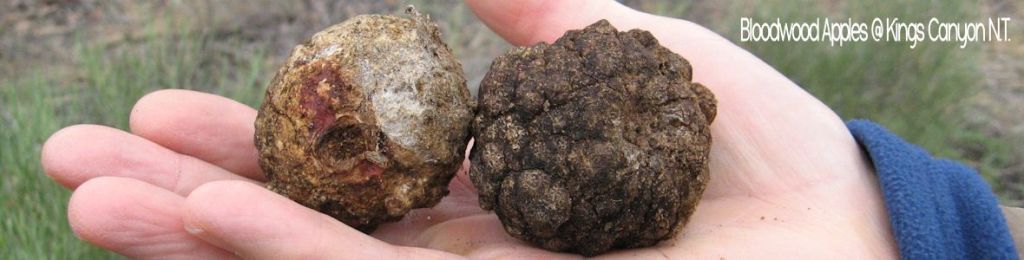
Bloodwood
Occurs over wide areas of the country reaching 15 metres. The bark is greyish and rough with clusters of pale yellow blossoms which are followed by vase-shaped gum nuts. A dark red sap oozes from wounds in the trunk.
The blossoms contain a sweet nectar and if you dunk them in a mug of water the result is a sweet nutritious drink. The Native Bee prefers to build its hive in this tree and it is on this tree that Lerp Scale can be found on the leaves. The main fork of the tree traps water.
If you mix the sap with water and drink it it can relieve general sickness and diarrhoea. It is also useful as an antiseptic and can be used for tanning animal skins.
Boab
Bramble Wattle
Bush Banana
Bush Guava
Bush Lemon
Candle Nut
Cassowary Gum
Cluster Fig
Cocky Apple
Coolibah
Corkwood
Cotton
Dugulla
Emu Apple
Poison
Freshwater Mangrove
Geebung
Gobin
Golden Grevillea
Grass
Green Plum
Grey Mangrove
Guava
Gulf Plum
Johnson Satin Ash
John River Almond
Kalumburu Almond
Kurrajong
Lady Apple
Leichhardt
Little Gooseberry
Mango
Native Apple
Native Pomegranate
Nonda Plum
Nutmeg
Onion Wood
Pacific Rosewood
Pandanus
Peanut
Plumwood
Blue Quandong
Blue Quandong grows in tropical rainforest with blue fruit appearing from December to February. Not particularly nutritious. Red Quandong grows in the arid inland and relies on the Wattle Tree as its host. The red fruit appears from July to October. Contains twice as much Vitamin C as an orange.
Sandpaper Fig
Grows along the east coast from Queensland to Victoria to a height of about 3 metres with broad dark green leaves with a rough texture making them ideal for use as “sandpaper”.
The entire fig is edible raw and has an excellent flavour.
She-Oak
Found in the coastal sand dunes across the Top End, right down the Queensland coast and around Perth and the Swan Valley, this tall graceful tree has small woody “oak-apples” from December to February.
The wispy leaves and sometimes the oak-apple were chewed as a thirst-quencher, their acidity activating the salivary glands. The roots have been known to yield drinkable water.
An infusion of inner bark was used as a mouth wash (not swallowed) to relieve sore throats and toothaches.
Silk Cotton
A large stout tree native to Cape York, Darwin and the Kimberley prefers to grow on the dry edges of watercourses. The trunk is covered with cone-shaped prickles. From July to September the tree produces red or orange flowers which soon fall to the ground.
You can roast the edible tap root. The wood of the tree trunk was used to make canoes, whilst the inner bark was made into strong twine.
Soap Tree
A small tree it is particularly common along creeks. Smooth grey bark, rich green leaves and small sweet scented cream-green flowers. Masses of red-black berries.
Crushed berries and leaves were crushed and floated in a pool of water to poison fish, however that action also renders the water undrinkable so is only used in an emergency.
If you rub the leaves vigorously they will lather like soap.
Strychnine
Common in northern Australia the bushy tree grows to about 5 metres and produces orange fruit from February to August. The fruit is poisonous.
The fruit and bark of the tree were mashed up to use as a body wash to help cure general illness. It was also used tossed into small pools of water to stun the fish which soon floated and were caught by hand before being cooked and eaten.
Tamarind
Introduced to the Top End hundreds of years ago, it grows to 25 metres with feather-like leaves. Elongated brown pods hang from the tree from June to October. Inside the pods there’s a rusty coloured flesh with shiny brown seeds.
The flesh, rich in phosphorous and calcium, is tart and can be soaked in water to make a refreshing drink. Too much and it has a laxative effect. Young plants, leaves and flowers can be cooked and eaten.
Tennis Ball Fruit
Native to Cape York with tree has a weeping willow look and produces fruit from December to February and then again from June to October. They are yellow when ripe.
The gritty dry flesh of the fruit has a banana-ish taste. The seeds should be discarded.
The fruit, inner bark, and the roots was heated and used as a poultice for broken bones, sprains, joint dislocations.
Tree Fern
Large tree ferns are native to the coastal rainforests in far north Queensland but can be seen along the length of the Great Dividing Range and in suburban gardens.
They grow to over 5 metres. The young fronds are curled and covered in brown hairs which, when removed enable the frond to be eaten raw. However if they are washed and cooked the bitter taste is removed.
Tropical Almond
Native to the Queensland coast, the tree grows to 20 metres and produces green to red tapered pods from January to April. Inside is a single elongated almond which can be eaten raw. It has a crisp texture, nutty flavour and high ratio of oil. The pod casing makes good homes for rodents and sand crabs.
White Aspen
Occurring naturally along the Queensland coast this is small tree with rich green leaves. It produces tiny white flowers which form yellowish globular fruit from July to October.
The flesh of the fruit surrounding a single large seed has a sweet-sour taste depending on the maturity of the tree.
White Wood
From the Kimberley, across the Top End to Cape York this small tree to about 5 metres. As a sapling it looks like a fern and then as it matures it looks like a white gum. Saplings appear at the start of the Wet Season (around December/January).
Saplings were harvested for their tap root which was consumed raw. Older roots were baked on hot coals to soften their fibrous nature.
Wild Orange
This tree favours open forest country of Cape York, south east Queensland, north coast New South Wales and a pocket around Sydney. The small scruffy tree produces round ball like fruit in the Wet Season which has a bright orange pulp and large hard seeds.
The orange/yellow pulp is eaten but the seeds are discarded.
Also known as Native Caper.
The second Wild Orange grows in dry open country from central Australia across to Queensland. It fruits from November to February, turning yellow when ripe they drop to the ground. The flesh tastes like mango and it’s best to swallow the small round seeds whole without chewing.
Also known as Native Pomegranate
Wongi Plum
Found in the Torres Strait and Cape York region the 6 metre trees have a distinctive silvery appearance. It fruits from July to September, which mature to an orange-red colour with a couple of seeds inside.
Ripe plums can be eaten raw. They are also liked by Torres Strait Pidgeons and Fruit Bats.
They were often buried to speed up the ripening process.

 Bush Tucker Recipes at the Aussie table