Bloodwood Apple
These can be found on a variety of eucalypt trees (including Bloodwood Trees) across all but the greenest parts of Australia. Between the size of a golf ball and a cricket ball, when cracked open you’ll find a pink or white lining with an edible grub which tastes like coconut. Just pop them in your mouth and enjoy!
Tree Orchid
Found in the northern half and east coast of Australia attached to branches of eucalyptus trees.
Once the pods turns brown the kernel can be eaten raw and has a similar taste to peanuts.
The juice from the stems were used as a glue and applied directly to wounds (particularly burns)
Vines
Bitter Yam
Native to the coastal regions of the Kimberley in north west Western Australia to the Coburg Peninsula in the Northern Territory the yam is poisonous unless prepared correctly. It would be sliced, then washed in running fresh water for two days minimum before being mulched into a cake and then baked on hot coals. Even after all that only a small portion would be eaten and care had to be taken to keep it away from the eyes and mouth
Bush Banana
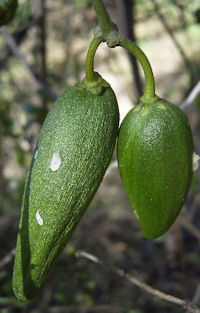
Also known as Native Pear, the Bush Banana (Marsdenia) is now under cultivation in parts of South Australia. It thrives in drier areas where rainfall inspires the vine to fruit from November to April. It is nice raw – looks like an avocado but tastes like fresh green peas. They were sometimes cooked on hot ashes and the vine’s flowers were sucked for nectar and/or eaten raw
Bush Passionfruit
A scrambling vine that is common across the northern parts of Australia from Byron Bay in New South Wales to Port Hedland in Western Australia. It loves the humid tropics, producing small fruit about the size of a marble that turn from green to yellow when fully ripe. (Green fruit are toxic)
Bush Potato
Native in the region from Darwin to the Ord River, this plant looks like a piece of grass growing to about 30cm high with a tuber attached. Most easily found immediately after the wet season. Bush fire destroys them. Raw or cooked they have a nutty taste.
Cape Gooseberry
Found on the west coast of Cape York and the coastal fringes south of Darwin, the round green fruit is encased in a papery capsule which turns brown and brittle as the fruit matures. Eaten raw.
Caustic Vine
This leafless vine is fairly wide spread across the continent. The green, pencil-thick, succulent branches exude a white sap when broken which was used to stop wounds bleeding, cure sores and skin rashes. It is corrosive so must be kept away from mouth and eyes.
Creeping Hibiscus
Also known as Bush Carrot this low ground creeper is native to the northern coastlineof Western Australia and Queensland. It begins it’s growth at the start of the wet season and dies back in winter. It has a small edible tuber which can be easily dug up and eaten raw or cooked. You can also eat the young leaves and shoots.
Desert Yam
In the sandy soil of central Australia the Desert Yam appears after rain producing a pink trumpet shaped flower and distinctive heart shaped leaves. The edible underground tubers (bush potato) cause the ground to crack as they grow so are easily located. An important staple they are usually roasted.
Devil’s Guts
A parasitic leafless vine native to the top half of the country producing green berries, slightly smaller than a pea, were sometimes eaten raw in small quantities as large doses produce stomach cramps or worse. The juice extracted from the vines was applied directly to ulcers and lacerations.
Gidgee Gidgee
Native to the northern and eastern regions, the gidgee gidgee are extremely poisonous. The shiny red seeds were used as fish poison and just one, if crushed and swallowed, is enough to kill a person.
Goat’s Foot
Most people will have seen this vine with it’s purple bell shaped flowers responding to the sun. Also known as Beach Morning Glory it can be found on the sandy shores of the tropical Atlantic, Pacific, and Indian Oceans. It is poisonous if not prepared correctly. The leaves (Heated on hot rocks and then applied as a poultice.) were used to relieve stings and bites from insects, stingrays and snakes as well as a cure for skin irritations, boils, skin infections, ringworm and haemorrhoids.
Gulaka
The Wild Mung Bean comes to life in the tropical wet season. The tuber looks like a long white parsnip tastes like sweet potato and can be eaten raw or cooked.
Headache
Can be found from Cairns up to the tip of Cape York. The leaves are crushed and hands cupped so that the aroma can be inhaled to cure headache, head colds and sinus. The sap can be an irritant so wash your hands immediately after treatment.
Kalumburu Yam
This heart-shaped leaved vine can only be found in the Kimberley primarily in the dry season. The large lumpy yams are roasted over hot coals and taste very much like boiled potato.
Lawyer
Prolific and prickly this vine is found in Queensland’s tropical rainforest with edible berries appearing near the climbing end of the vine from November to February. The slightly sour berries are eaten raw. The hooks on the long flexible thongs of the vine were used to snag freshwater prawns, and extract witchetty grubs from rotting logs. The cane also contains drinkable water and were also used to construct fish and animal traps. You can also scatter the palm-like fronds around a cmap site to discourage leeches.
Long Yam
A climbing vine with broad rich green heart shaped leaves, it has a distinctive seed pod. The whitish-brown tuber or yam is located well below ground level. Eaten raw or roasted they taste like potato.
Maloga Bean
A very thin twining vine with long parsnip-shaped edible roots which was usually roasted and tastes like potato. Native to the region bounded by far western New South Wales, north to the Kimberley coast and in Queensland from the Tropic of Capricorn to the tip of Cape York.
Matchbox Bean
A robust climbing vine native to the east coast of Cape York produces a poisonous giant hanging bean. The white section of the bean was extracted, baked and pounded to produce a sort of flour that was soaked in fresh water and eaten as a bland, tasteless “porridge”. The bark and stem were soaked in water and crushed with the resulting toxic lather used as a soap and fish poison.
Wild Grape
Common in Arnhem Land and Cape York they are easily spotted at theend of the Wet Season and from February to May small clusters of grapes are produced – very dark purple when mature. The fruit can be eaten raw – the initial sweet taste is soon replaced with a slight harmless burning sensation. Juice from the roasted roots was used as an antidote for Death Adder.
Native Grape
This particular native grape (cissus hypoglauca) can be found down the east coast from Queensland to Victoria. Bunches of purple grapes appear from February to May. Like the Wild Grape, they are eaten raw with the initial sweet taste soon replaced with a burning sensation. Three or four grapes will usually do you.
Native Monstera
A climbing vine in northern Queensland growing in the rainforest canopy so the fruit is rarely seen from the ground and take months to ripen. The soft pink flesh tastes like a spicy fruit salad.
Oenpelli Grape
Found along the coastal north of Queensland and Northern Territory, this vine produces purple-black grapes from the wet season to the middle of the year. Like the Native Grape and Wild Grape the initial sweet taste is soon replaced with a slight harmless burning sensation
Paddymelon
Poisonous, this melon appears following rainfall and looks and smells edible. The juice was used to treat skin infections, ringworm and scabies.
Round Yam
Poisonous, this underground yam grows the size of an onion and can be found from the Kimberley, Kakadu, Arnhem Land, and from Cape York down the coast to Byron Bay. It needs extensive soaking and boiling before eating. Tastes like boiled potato.
Supple Jack
Can be found in the same areas as the Round Yam (above) and grows throughout the year. The young leafy shoots and terminal buds are eaten raw or cooked and taste like spinach. The berries which appear at various times of the year and edible along with the flowers. Young shoots were crushed and mixed with water and drunk to relieve toothache, sore throat and chest complaints. The stems are useful for basket weaving.
Wild Cucumber
Native to the region from outback New South Wales, South Australia and Queensland through to the Kimberley, the fruit is in season from March to May. When it falls off the vine, the cucumber tasting fruit is eaten raw.
Wild Indigo
Can be found year round along the northern coastline and was used as fish poison – the stunned fish would float to the surface and then cooked in the usual way.

 Bush Tucker Recipes at the Aussie table